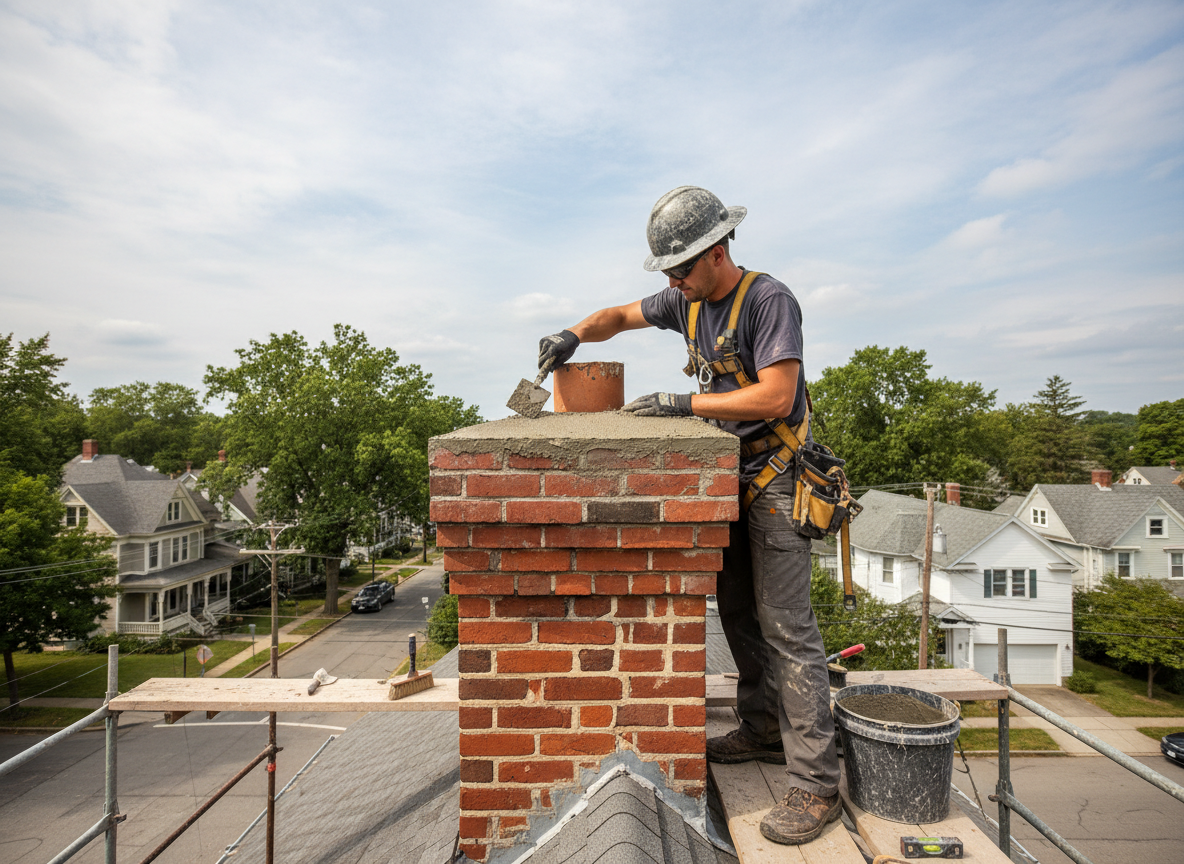
Chimney crowns in Clinton take constant abuse from the semi-arid climate’s freeze-thaw cycles. Hot summer days followed by cold snowy winters open hairline cracks that let water past the flashing and into the masonry. In neighborhoods like Clinton Central and West Clinton, many homes built before 1990 still carry original crowns that were poured without modern expansion joints, so a small crack today often becomes a full rebuild within two winters.
We use a 5,000-psi concrete mix with fiber reinforcement and a 2-inch drip edge that throws water clear of the chimney walls. When working on roofs near Clinton City Park or along 1500 West, we also check the counter flashing where the crown meets the chase because wind-driven snow from the north frequently packs behind standard flashing. Edge cases include shared chimneys on duplexes in West Clinton where one owner’s repair can affect the neighbor’s draft.
Davis County code requires a minimum 2-inch overhang on all new crowns, and we pull the old crown completely rather than patching so the new pour bonds directly to the flue tile. Homes near Ogden, Roy and Clearfield often see extra soot staining on the crown because prevailing winds carry emissions from the refineries; that carbon accelerates acid rain damage to the concrete surface.
Before any repair we camera the flue to confirm the crown failure has not already allowed water into the smoke chamber. This step prevents callbacks when a homeowner thinks the crown alone was the only issue.
Technician insight
In Clinton the thing that catches most people out with Chimney Crown Repair is the wind-driven snow that packs behind the flashing on the north side of the chimney. Homes in West Clinton and near Clinton City Park sit lower and catch extra drifting, so a crown that looks intact from the ground can still be letting water in at the back edge.
Cracked Crown on 1980s Home in Clinton Central
Homeowner noticed water stains on the ceiling after a heavy January snow. Camera showed water tracking down the flue from a crown split open by repeated freeze-thaw. We removed the old crown, repoured with proper overhang and reset the flashing. No further leaks the following winter.
How it works
- 1
Site Inspection and Flue Camera
We examine the crown, flashing and surrounding masonry from the roof and run a camera down the flue to locate any water tracks or creosote blockages.
- 2
Old Crown Removal
The existing crown is cut free and lifted off in sections so we can inspect the top course of brick and the flue tile collar joint.
- 3
New Crown Pour
Fiber-reinforced concrete is formed with a proper drip edge and expansion joint, then finished with a slight pitch to shed water.
- 4
Flashing Integration and Cure
Counter flashing is reset or replaced and the new crown is allowed to cure before we leave the site.
Pricing
Upfront quotes after inspection; most Clinton crown repairs fall into a mid-range bracket depending on access and whether flashing must be replaced.