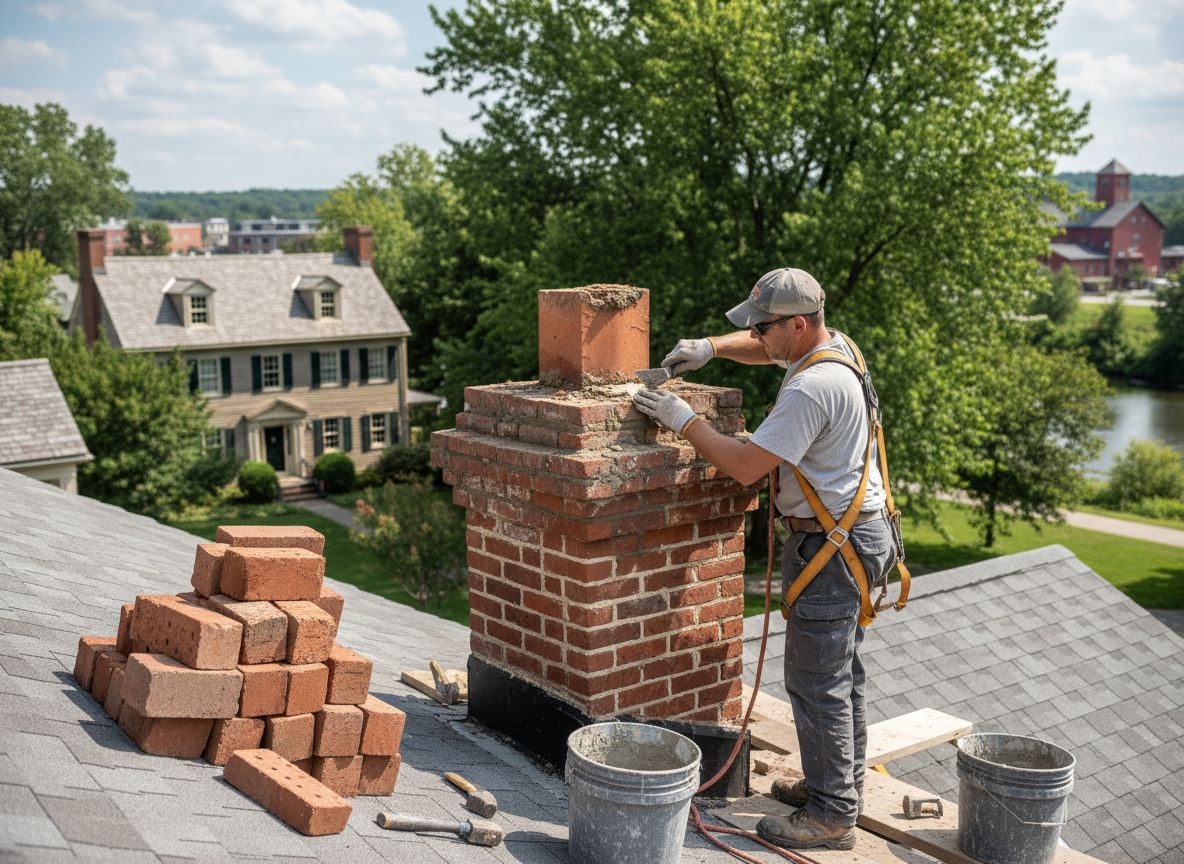
Clinton sits in a semi-arid zone where hot summers dry out masonry while cold snowy winters drive repeated freeze-thaw cycles that crack crowns and mortar joints. Homes in Clinton Central and West Clinton often feature older brick chimneys tied to single-story ranchers built when the area grew after the 1970s. These stacks see heavy wind-driven snow from the west that piles against the flue, forcing water behind the brick and rusting the damper plate inside. A missed hairline crack here lets carbon monoxide track into the attic during the next heating season.
Repair work in this county frequently involves rebuilding the crown with a reinforced concrete cap sloped to shed meltwater before it reaches the flue tile. We also see failed clay liners in homes near Clinton City Park where roof valleys direct snow load straight onto the chimney shoulder. Replacing the liner requires dropping new stainless sections from the top while the crew works around existing power lines that run close to many West Clinton rooftops. Skipping the proper flashing tie-in at the roof deck is the fastest way to create a leak that shows up only after the first spring rain.
Ogden and Roy crews sometimes bring different techniques suited to heavier industrial soot, but Clinton jobs center on residential masonry that has already taken twenty or thirty winters of expansion and contraction. We always pull the rain cap and camera the full flue length before any tuck-pointing begins, because a single blocked offset in a Clearfield-adjacent chimney can turn a simple crown repair into a full reline once draft is tested under load.
Technician insight
In Clinton, the thing that catches most people out with Residential Chimney Repair is the way heavy snow drifts against the west side of chimneys in West Clinton push meltwater straight into the flue tile; once that happens the first thaw opens hidden cracks that only show when the furnace runs hard in January.
Crown Failure After Heavy Snow
Homeowner in Clinton Central reported water marks on the ceiling after a March melt. Inspection showed a cracked crown and eroded mortar where snow had piled against the stack. We rebuilt the crown with a sloped cap and repointed the joints. The flue now sheds water cleanly through the remaining winter storms.
How it works
- 1
Site Inspection
We examine the crown, flue, and flashing from roof level and inside the home, noting any offset or water staining specific to Clinton roof pitches.
- 2
Damage Mapping
Camera survey and moisture checks identify cracks or liner failure caused by repeated snow load and freeze-thaw in Davis County winters.
- 3
Repair Execution
Crown rebuild, mortar tuck-pointing, or stainless liner insertion performed with materials rated for local temperature swings.
- 4
Draft and Safety Test
Final burn test confirms proper draft and verifies no carbon monoxide paths remain before the crew leaves the 2267 N 1500 W shop.
Pricing
Upfront quotes issued after inspection; final cost driven by liner length, crown rebuild size, and any offset corrections needed.